

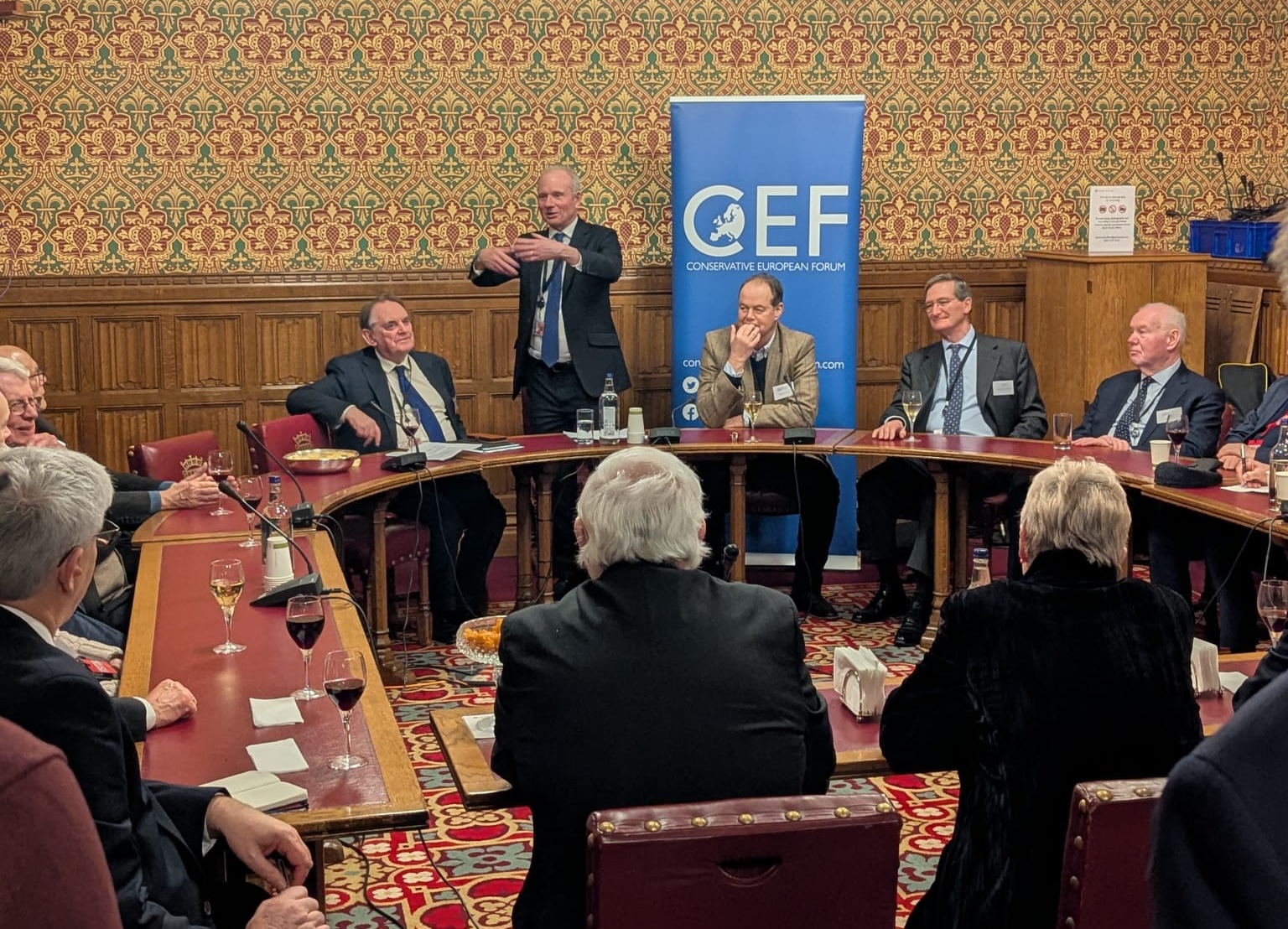
At this year's President’s Reception, Sir David Lidington spoke on European defence and security, telling members that we are reaching the end of an 80-year era during which Europe could assume automatic US protection for its security.
Warning signs have been evident since the Bush administration, yet successive European governments failed to respond decisively. Recent developments have only sharpened this reality. The imposition of tariffs on allies rather than ideological adversaries, open discussion about seizing European democratic territory, and an increasingly transactional approach to alliances underline a profound shift in American strategic priorities.
“The imposition of tariffs on allies rather than ideological adversaries, open discussion about seizing European democratic territory, and an increasingly transactional approach to alliances underline a profound shift in American strategic priorities”.
This change is not limited to one presidency. Whether under a Republican or Democratic administration, the long-standing assumption of American support can no longer be sustained, as candidates face a more nationalist electorate and will make the case that Europe should be paying more for its security.
Europe remains heavily dependent on the United States for critical capabilities, particularly in intelligence, surveillance, and reconnaissance. These are not capacities for which a European substitute can be replicated overnight. Pragmatism, therefore, demands continued cooperation with the US in the short term. However, this must be met with a far greater sense of urgency on the part of European powers to increase their capability to act without the US, if necessary. This is an aim that will likely take more than a decade to achieve and will require the leadership of the UK and France to take advantage of our greater willingness to deploy.
"I have attended enough European Foreign Affairs Council meetings to know that our current approach to collective European security is not fit for purpose. We must seek to rebuild and strengthen the capabilities that existed under the Western European Union. This can only be achieved through a new European Defence Treaty, tied to NATO, and that is capable of providing an integrated framework for joint military action and coordination by a European Coalition of the Willing. This will avoid an outcome that gives Viktor Orbán a veto over European security".
The European Union will play a pivotal role within this framework. It is only by the EU acceding to such a treaty that we can effectively coordinate budgetary mechanisms and defence procurement amongst our fellow European democracies. This has become more attainable as leaders across Europe have witnessed Russia’s invasion of Ukraine. It will require difficult decisions and, above all, a greater sense of strategic urgency than is evident today. Defence industry leaders have been warning for some time about capacity constraints, supply chain concerns, and the time required to scale production. We should listen.
Russia’s GDP is a tenth of that of European democracies combined. We have within our power the ability to act for our own defence if we choose to. This means being prepared to have difficult conversations with the electorate and resisting attempts to put narrow national self-interest ahead of better arrangements for collective European security.